


All FSN Practitioners Should Learn from Sherlock Holmes | Disease Differentiation as the Primary Step in the "Threefold Differentiation" Approach
The "Threefold Differentiation" approach is the core clinical reasoning methodology in Fu's Subcutaneous Needling (FSN) therapy, and it is also the key to why the technique is easy to learn but difficult to master. It guides the entire clinical process, aiming to systematically analyze the patient's condition and define the direction of treatment.
The "Threefold Differentiation" consists of Differentiating the Disease , Differentiating the Condition , and Differentiating the Muscle :
· Differentiating the Disease involves clarifying the nature, location, and diagnosis of the disease.
· Differentiating the Muscle focuses on accurately identifying the "affected muscles" responsible for the symptoms.
· Differentiating the Condition entails assessing the progression of the disease, the patient's functional status, and their overall physical and mental constitution.
In clinical diagnosis and treatment, we often assume that "the site of pain is the site of pathology." However, the human body, as a sophisticated mechanism, is far more complex than we imagine. During a teaching ward round at Hubei's first dedicated muscle department, Dr. Fu Zhonghua, much like Sherlock Holmes, clearly demonstrated through a real case how the "FSN Threefold Differentiation" thinking penetrates surface appearances to uncover the truth, thereby achieving precise treatment.
Upon hearing that Dr. Fu was coming for the ward round, the doctors were immensely excited and rubbed their hands in anticipation, presenting him with "challenging and complicated cases." Among them, a case involving a patient with neck and shoulder pain is particularly worth our collective study and reflection.
Patient: Male, 73 years old.
Chief Complaint: Pain in the neck and shoulder region for over half a month, aggravated and accompanied by right shoulder pain for 4 days.
Present Illness: The patient reports experiencing dull pain and discomfort in the neck and shoulder region starting half a month ago. The pain was located in the posterior neck and the right scapular area, worsening with movement or fatigue and slightly alleviating with rest. He self-administered topical analgesic patches. Four days ago, he developed a stabbing pain on the medial side of the right scapula, which persisted without relief. After taking oral painkillers at home, the symptoms improved slightly. Currently, the patient still experiences pain and discomfort in the neck and shoulder, particularly severe pain in the right scapular area, which affects his daily life. Seeking systematic diagnosis and treatment, he presented to our hospital and was admitted to our department with an outpatient diagnosis of "Cervicoscapular Syndrome".
Auxiliary Examinations:
Chest CT indicated: interstitial inflammation in both lungs; multiple small nodules in both lungs; intrahepatic bile duct stones or calcifications; cystic lesion in the right kidney.
Cervical MRI indicated: ischemic infarct focus in the pons; degenerative changes in the cervical spine.
Preliminary Diagnosis:Cervicoscapular Syndrome.
Treatment Course:Conventional treatments were administered, including analgesic medication, physical therapy, targeted massage and acupuncture (including FSN) for the neck and shoulder region, as well as ultrasound-guided peripheral nerve block. After over ten days of hospitalization, the patient reported that symptoms had "slightly improved" and there was "some relief." This represents a common, moderate treatment outcome but failed to achieve significant or fundamental alleviation.
During the ward round, Dr. Fu listened attentively to the doctor’s report of the diagnosis and treatment process described above. After conducting a detailed inquiry and physical examination of the patient, he rested his chin in hand, pondered briefly, and said to us, “In such a situation, we need to re-evaluate the diagnosis.”
The first step was Differentiating the Disease. Both the patient and the attending physician had provided a clear history, yet Dr. Fu, after analyzing the case, sensed there might be missing pieces. He therefore repeatedly asked the patient to review the medical history in detail. Eventually, a previously overlooked detail emerged: the patient mentioned a history of chronic cholecystitis. Although there had been no typical severe pain in the upper right abdomen recently, Dr. Fu pressed further, asking whether there were any abnormalities after eating. The patient replied that they often experienced vague discomfort such as bloating and belching after consuming eggs.
At this point, Dr. Fu, much like a detective, had seized the critical clue. He reminded us that we must remain highly vigilant: visceral diseases (especially those involving the gallbladder, heart, or diaphragm) can often cause referred pain, which may manifest as pain in the shoulder or back.
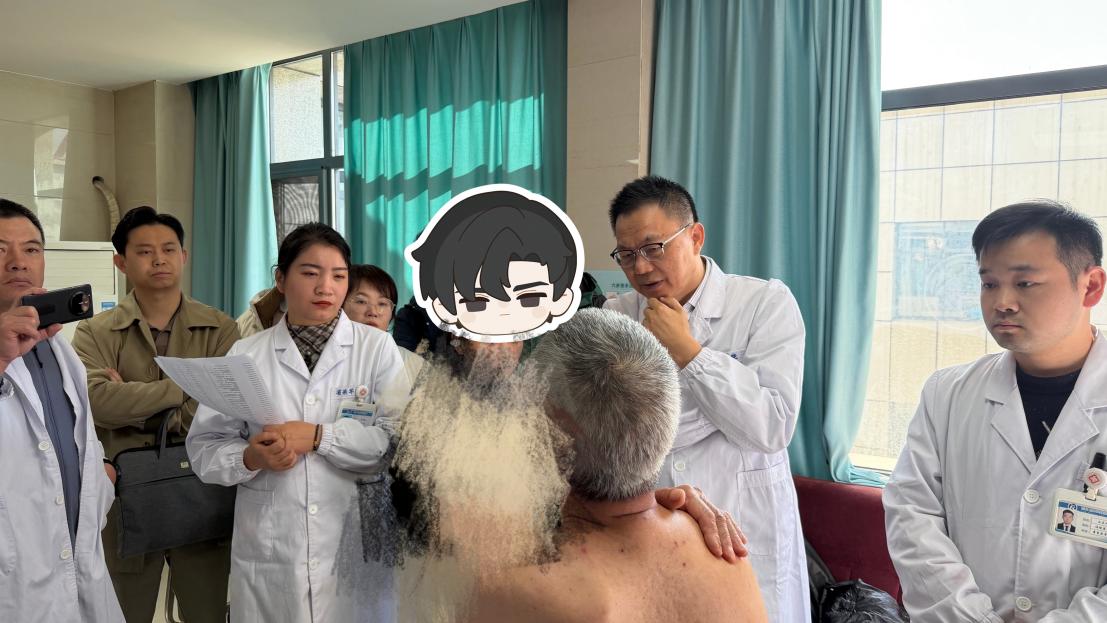
As the truth gradually came to light, the second step was Differentiating the Muscle . Dr. Fu guided us to move beyond simply palpating the painful supraspinatus and trapezius muscles. Instead, based on functional anatomy, we systematically examined potential "reactive points" or "affected muscles" that might be linked to visceral referred pain. We focused on assessing the right subscapularis and serratus anterior muscles, and particularly the intercostal muscles and upper segments of the rectus abdominis, which are closely related to thoracic function and diaphragmatic activity.
Palpation revealed abnormal tension and stiffness in the abdominal wall muscles. This strongly suggested that the root cause of the pain signal might originate from the abdominal cavity. Through neural reflexes, it could have led to functional disturbances in specific muscles (forming "affected muscles"), which subsequently manifested as shoulder pain.
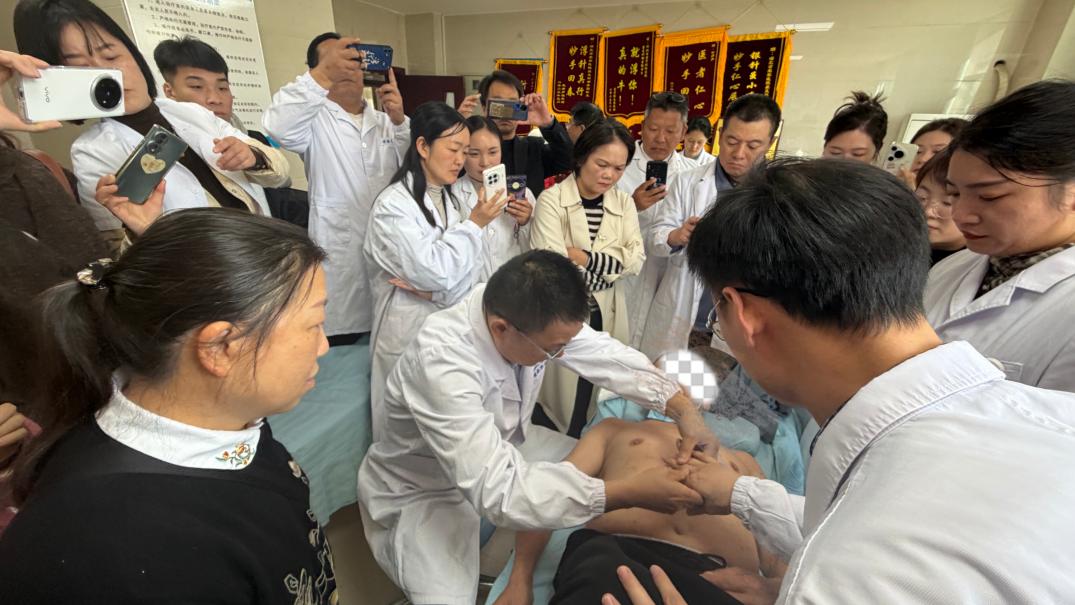
Dr. Fu provides hands-on, step-by-step instruction to doctors on how to palpate affected muscles.
Dr. Fu then proceeded to needle the upper segment of the patient's rectus abdominis. As soon as the floating needle was fully inserted, the patient noticeably let out a sigh of relief. Following scattering and reperfusion maneuvers, the patient immediately reported significant relief from the deep, heavy, pulling pain in the shoulder.
Everyone present experienced a moment of enlightenment, filled with the joy of cracking a case. Subsequently, Dr. Zou Shengqin, the head of the muscle department, conducted a follow-up phone call with the patient. The patient reported that the pain occasionally recurred but was much milder than before. Dr. Zou advised the patient to continue with further Fu's Subcutaneous Needling (FSN) treatment.
This case profoundly demonstrates the core value of the "Three Differentiation" approach in Fu's Subcutaneous Needling: it ensures we do not lose ourselves in local symptoms, encourages questioning initial diagnoses, broadens the scope of differential diagnosis, and shifts focus from "treating the manifested disease" to "seeking the root cause of illness." It guides our hands and needles beyond the "superficial pain zones" to accurately locate the affected muscles for intervention.
The true mastery of Fu's Subcutaneous Needling lies not in the needling technique itself, but in the ability to skillfully apply the "Three Differentiation" mindset. Like a brilliant detective, one must penetrate through layers of phenomena to ultimately uncover and resolve the complex truth behind the disease.
Especially for Pre-muscular pain, it requires particularly careful consideration.
Author Biography
Zou Shengqin
Fu's Subcutaneous Needling Level I Practitioner
Head of the Muscle Department, Hubei Provincial Veterans Support Hospital
Council Member of the World Federation of Chinese Medicine Societies (WFCMS) Fu's Subcutaneous Needling Professional Committee
Standing Committee Member of the Fu's Subcutaneous Needling Professional Committee, Hubei Provincial Association of Chinese Medicine Practitioners
Affiliation: Hubei Provincial Veterans Support Hospital
Fuzhen (Fu's Subcutaneous Needling) Clinic, Department of Rehabilitation Medicine
Contact (WeChat same as phone): 18086423251

-
Profile
-
Teaching
-
Treatment Methods
-
Science Popularization
-
Department of Myology